Training Management
Training records that stay current — automatically.
When a document changes, affected staff are assigned, notified, and tracked to completion. Your training matrix is always audit-ready.
A Training Matrix in Excel Is Out of Date the Day After You Reconcile It.
Training records live in a spreadsheet maintained by one heroic coordinator. New hires start work before their file is complete. An SOP revises and half the team never reads it. Competency assessments drift past their due dates until an inspection announcement triggers a reconciliation sprint.
The exposure is personal and specific: an inspector picks one tech and one procedure, and asks for evidence of training on the current revision and competency within the cycle. Either the record exists in seconds, or the finding writes itself.
What CLIA, Part 211.25, and ISO 13485 Require From Training Records
CLIA requires documented training and semiannual-then-annual competency assessment for testing personnel, in six defined elements. Part 211.25 requires training in current good manufacturing practice, on a continuing basis, by qualified individuals. ISO 13485 clause 6.2 requires competence to be determined, training provided, and effectiveness evaluated.
A spreadsheet records intentions. Kintavo records evidence: assignments driven by role and document, completions signed by trainee and trainer, and competency cycles that schedule themselves.
The old way, retired.
This is the actual screen.
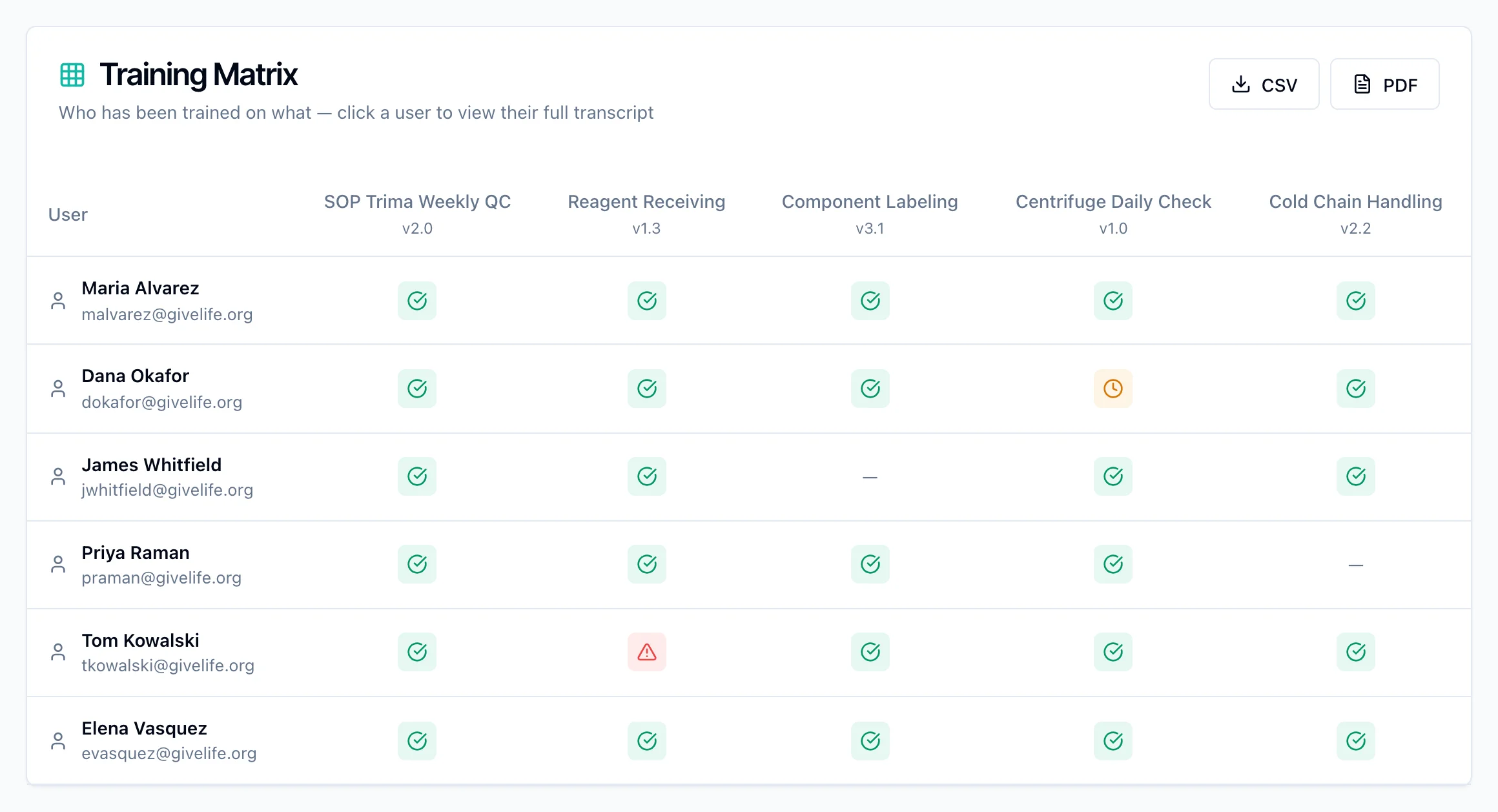
Assigned by Role. Triggered by Change. Proven on Demand.
The phlebotomy SOP goes to revision D on Monday. By Tuesday, all twenty mapped staff have a read-and-understood task; three flagged for full retraining get sessions scheduled. A float tech transferring to chemistry picks up that role’s curriculum automatically — and cannot sign chemistry QC steps until initial competency is signed off. At the CAP inspection, the assessor picks two names at random. Both records open in under ten seconds.
Part of one connected system.
Training Management shares the same data model, AI engine, and audit trail as the other eighteen modules — so its records see, and are seen by, everything else in your quality system.
Training Management FAQ
Does Kintavo handle CLIA competency assessment?
Yes — all six elements, with observation checklists, blind-sample results, and trainer signatures, on the semiannual-first-year-then-annual cycle, scheduled automatically per person.
What happens when an SOP is revised?
Everyone mapped to the document gets a training assignment when the revision goes effective — read-and-understood or full retraining, per your rules — and the matrix updates as completions come in.
Can Kintavo block unqualified staff from performing work?
Yes. Workflow steps can require current training and competency; an operator who lacks them cannot sign the step. That is enforcement, not reporting.
Can we import existing training records?
Yes. Historical records load per person with completion dates and evidence attached, so your matrix is complete from day one — no retroactive re-training.