AI Smart Assist™
Semantic search and gap detection across every record.
Ask questions in plain language and get answers across every record type — with gaps and contradictions surfaced before an inspector finds them.
Your Quality System Knows the Answer. Finding It Takes a Week.
The answer to almost every quality question already exists in your records — scattered across deviations, training files, maintenance logs, and document revisions. Keyword search finds the words; it does not find the answer. So the question goes to the person who has been there longest, and the answer depends on their memory.
The exposure shows up at the worst time: during an inspection, when "do we have any other events like this?" must be answered completely, and quickly, or the inspector concludes you cannot see your own system.
AI in a Part 11 Environment: What Has to Be True
AI in regulated quality has one non-negotiable: it must never alter the record. Kin — Kintavo’s assistant — reads your records and drafts answers, summaries, and gap analyses, but every record change remains a human action under a Part 11 signature. The audit trail shows who did what; the AI is never the who.
Data boundaries hold the same line: Kin answers only from your organization’s data, is never trained on it, and every answer cites the records it drew from — so the human verifying the answer can check the sources in one click.
The old way, retired.
This is the actual screen.
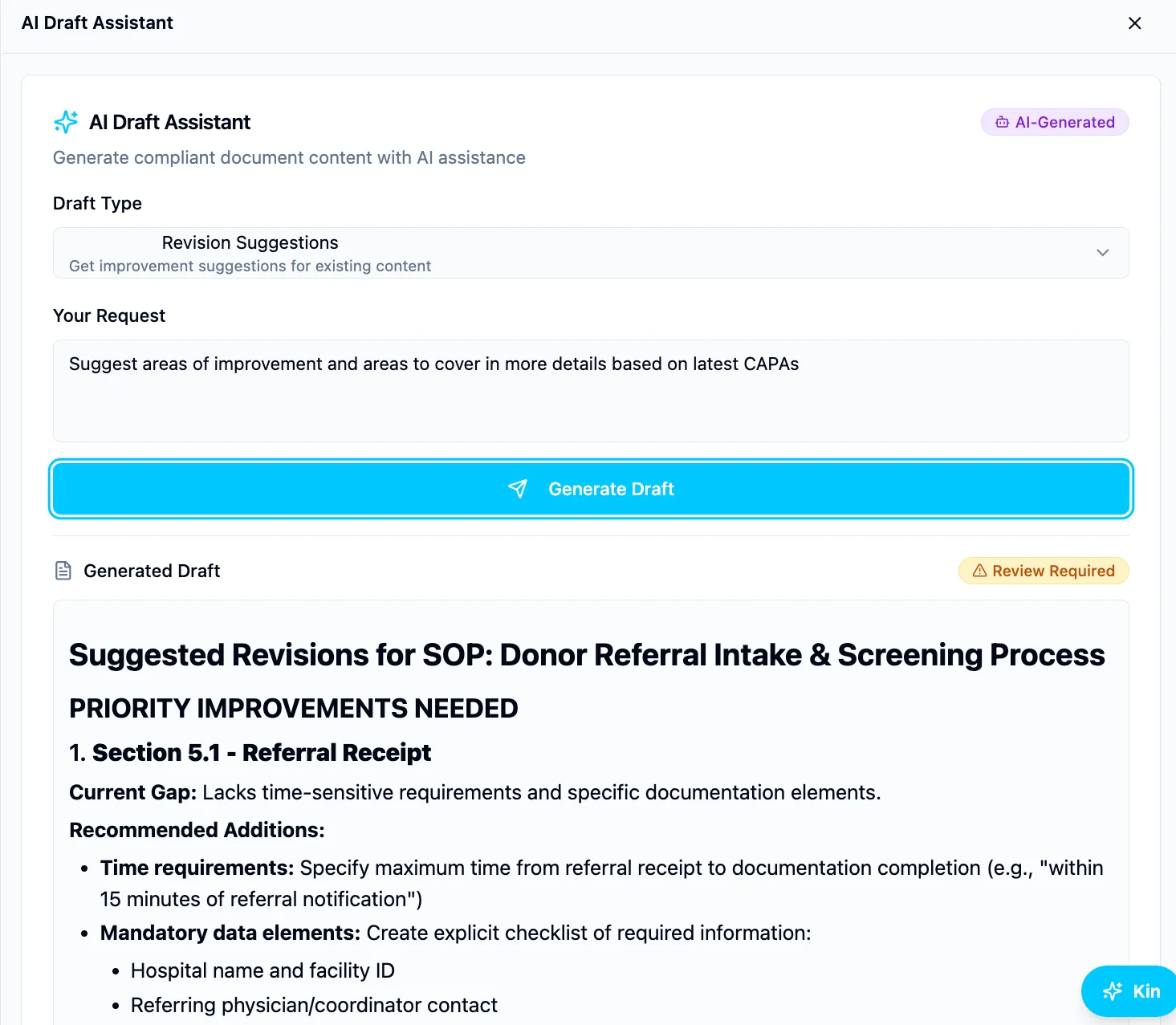
Ask the System. Verify the Sources. Sign It Yourself.
An inspector asks whether the lab has seen similar centrifuge failures before. The quality manager types the question as asked. Kin returns three related events across four years — two deviations and a maintenance record — each cited. She opens the sources, confirms the matches, and hands over the summary she reviewed and signed. Elapsed time: four minutes, in the room.
Part of one connected system.
AI Smart Assist™ shares the same data model, AI engine, and audit trail as the other eighteen modules — so its records see, and are seen by, everything else in your quality system.
AI Smart Assist FAQ
Can the AI modify our quality records?
No. Kin reads and drafts; humans decide and sign. Every record change is a named human action under a Part 11 signature, and the audit trail proves it.
Is our data used to train AI models?
No. Kin answers from your organization’s records only, your data never trains any model, and every access is logged like any other system access.
How do we validate an AI feature under Part 11?
The same way you validate the rest: Kin is assistive, not decisional, so validation covers the human workflow around it. Kintavo provides the documentation package covering intended use and boundaries.
How accurate are the answers?
Every answer cites its sources, so accuracy is verifiable at the moment of use — the reviewer checks the cited records before acting. Uncited assertion is not something Kin produces.