eQMS for Blood Banks & Transfusion | Kintavo
CLINICAL OPERATIONS & CARE DELIVERY

Blood Banks & Transfusion

AABB, FDA, and ISBT-aligned workflows for blood banks, transfusion services, and apheresis programs.

AABB 21 CFR 606 ISBT 128
Book a demo for blood banks ← All industries
THE PROBLEM

In Transfusion Medicine, a Quality Gap Is Measured in Patients.

Blood banking carries the least forgiving quality mandate in the laboratory world: every unit traceable donor to recipient, every reagent qualified daily, every deviation reportable — some to FDA within days. The BECS tracks units; everything around it — QC, competency, equipment, deviations, document control — typically runs on paper and spreadsheets under AABB assessment.

The lookback is the stress test: an implicated donation, and every downstream component, recipient, and record must be found — completely and provably. Paper systems answer in days and end in doubt.

REGULATORY REQUIREMENTS

What AABB Standards and 21 CFR 606 Require From Transfusion Quality

AABB Standards require a quality system across the whole operation: qualified reagents, calibrated equipment, competent personnel, controlled documents, and deviation management with defined reporting. 21 CFR 606 adds GMP for blood: records for each significant step, retained and traceable. Part 606.171 requires biological product deviation reports to FDA — with the clock running.

Kintavo runs that quality layer alongside your BECS: daily reagent QC signed at the bench, deviations with BPDR-ready timelines, and every record born linked, ready for the lookback you hope never comes.

WHAT AUDITORS LOOK FOR
Reagent QC gaps — daily checks missing or batch-signed.
Deviations discovered late, or BPDRs filed past the reporting window.
Competency records that lag the techniques staff actually perform.
Lookback exercises that cannot prove completeness.
WHAT KINTAVO REPLACES
Reagent QC on paper logs → Daily QC signed at the bench, exceptions escalated
Deviation reports by memo → Structured events with BPDR timelines enforced
Equipment logs in binders → Calibration and PM on the asset, alarm-ready
Records scattered across paper and systems → Quality records born linked for the lookback
AABB prep as a project → Assessment-ready as the steady state
CORE CAPABILITIES

The Quality Layer Around Your BECS.

QC Analysis
Daily reagent and control QC with rules at entry — failed cells and reagents held before use, not after.
Deviation Management
Transfusion service events with severity rules, BPDR timeline enforcement, and lookback linkage.
Inventory & Supplies
Reagent lots quarantined until qualified — antisera, cells, and kits under expiry enforcement.
Equipment & Maintenance
Refrigerators, freezers, irradiators, and cell washers on enforced schedules with excursion events.
Training & Competency
Six-element competency per technique — crossmatch, antigen typing, apheresis — on cycle.
360° Compliance Map™
Quality records — QC, equipment, deviations, competency — linked as they are created, every hop signed.
WHAT IT LOOKS LIKE IN PRACTICE

A post-donation information call implicates a Tuesday donation. The quality manager opens the event: the linked records — receipt, QC, storage equipment — are already attached, and affected inventory quarantines from the record. The BPDR drafts from the event with the timeline intact and files inside the window. The medical director’s review is a reading, not a reconstruction.

EVIDENCE, NOT CLAIMS

Records Born Linked, Ready for the Lookback.

Deviations, QC runs, equipment events, and competency records link as they are created — so a lookback starts from connected evidence instead of four filing systems.
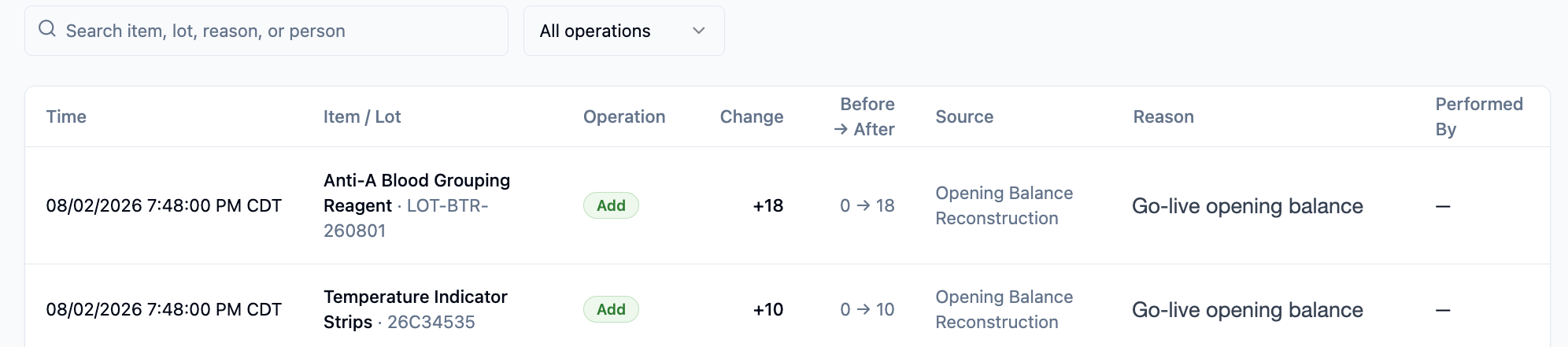
Signed, timestamped ledger rows — the linked evidence a lookback draws on
SHOWN WITH SAMPLE DATA. YOUR NUMBERS APPEAR THE DAY YOU CONNECT YOUR SYSTEM.

Configured for your rules from day one.

STANDARDS
AABB & 21 CFR 606 templates
Workflows, checklists, and record types pre-mapped to the standards your assessors walk in with.
DAILY QC
Automated daily quality control
Reagent and equipment QC captured at the bench, flagged against limits, and filed to the audit trail automatically.
TRACEABILITY
ISBT 128 chain of custody
Every unit, every movement, every signature — retrievable in seconds when the assessor asks.
“
"Kintavo is the perfect solution for a regional blood center because it grows with you. We can automate our daily quality control processes, improve efficiency, and reduce costs."
Hoxworth Blood Center University of Cincinnati
MOST USED BY BLOOD BANKS TEAMS
QC Analysis → Equipment Management → Calibration Tracking → Document Control → Deviation Management →
QUESTIONS & ANSWERS

Blood Banks & Transfusion FAQ

Does Kintavo replace our BECS?
No. The BECS remains the system of record for units and testing. Kintavo runs the quality system around it — QC, deviations, equipment, competency, documents — and integrates via API.
Can Kintavo handle biological product deviation reporting?
Events carry BPDR classification and timeline enforcement, with the report drafting from the record itself — so the 45-day window is managed, not remembered.
How does Kintavo support AABB assessments?
The daily workflows generate the evidence assessors sample — reagent QC, competency, equipment records, deviation handling — retrievable live during the assessment.
Who uses Kintavo in blood banking?
Hoxworth Blood Center — University of Cincinnati runs quality processes on the platform, alongside transfusion services within health systems like Avera and SCL Health.

See Kintavo configured for blood banks.

Bring your real pain points. We'll show you exactly how it solves them — in your regulatory language.

Book a Personalized Demo
RELATED Who runs on Kintavo → Hoxworth case study → Compare platforms → Pricing →